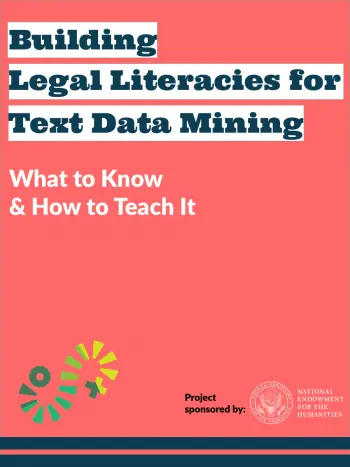
Author(s): Beth Cate, Brandon Butler, Brianna L. Schofield, Courtney Glen Worthey, David Bamman, Maria Gould, Megan Senseney, Scott Althaus, Thomas Padilla
Introduction
As someone who works closely with researchers, librarians, and digital scholars, I’ve seen one recurring challenge: understanding how law intersects with data-driven research. Building Legal Literacies for Text Data Mining addresses this exact gap. The work by Beth Cate, Brandon Butler, Brianna L. Schofield, Courtney Glen Worthey, David Bamman, Maria Gould, Megan Senseney, Scott Althaus, and Thomas Padilla offers a thoughtful, practical framework for navigating the legal dimensions of text data mining.
Text data mining (TDM) is transforming how we analyze books, articles, archives, and digital corpora. But with opportunity comes responsibility. Copyright, licensing agreements, privacy considerations, and fair use principles all shape what researchers can legally do with textual data.
This blog explores the core ideas behind Building Legal Literacies for Text Data Mining, why legal literacy matters, and how scholars can confidently conduct compliant research.
What Is Legal Literacy in Text Data Mining?
Legal literacy in the context of text data mining means understanding:
-
Copyright law
-
Fair use doctrine
-
Licensing restrictions
-
Data ownership
-
Contract law implications
-
Privacy and ethical boundaries
It’s not about becoming a lawyer. It’s about knowing enough to make informed, responsible research decisions.
The authors emphasize that researchers, librarians, and institutions share responsibility in building this literacy. When scholars understand the legal frameworks guiding their work, innovation becomes more sustainable.
Why Legal Literacy Matters in Text Data Mining
1. Protecting Researchers and Institutions
Misinterpreting licensing agreements or ignoring copyright restrictions can expose institutions to legal risk. Legal literacy minimizes uncertainty and supports compliance.
2. Enabling Confident Research
Many researchers hesitate to pursue text mining projects because of legal ambiguity. Understanding fair use and copyright exceptions empowers scholars to move forward with clarity.
3. Supporting Open Scholarship
Text data mining thrives when researchers can responsibly access and analyze large corpora. Legal literacy supports transparent, ethical digital scholarship.
Key Legal Areas Explained
Copyright and Fair Use
In many jurisdictions, copyright protects original works, including books, journals, and digital publications. However, fair use (or fair dealing in some countries) may allow limited use for research and educational purposes.
Text data mining often involves copying texts to analyze them computationally. The authors discuss how transformative use — analyzing text rather than redistributing it — may strengthen fair use arguments in some contexts.
Understanding how transformative analysis differs from redistribution is crucial.
Licensing Agreements
Libraries and universities frequently access digital databases under contractual licenses. These agreements sometimes restrict automated downloading or mining.
Researchers must:
-
Review license terms carefully
-
Consult librarians
-
Seek clarification before large-scale extraction
Contract law can override broader copyright exceptions, so licensing review is essential.
Data Ownership and Access
Questions often arise about who owns derived datasets. If you mine a corpus and generate metadata, topic models, or frequency counts, are those outputs yours?
The book encourages clear documentation and transparency. Researchers should maintain records of permissions and project scope to avoid disputes later.
Privacy and Ethical Considerations
Not all text data is publicly neutral. Mining social media posts, personal letters, or sensitive archives may raise ethical concerns.
Legal literacy includes understanding privacy frameworks and institutional review board (IRB) standards when human subjects are involved.
Practical Steps to Build Legal Literacy
From my experience, these steps make a difference:
1. Collaborate with Librarians
Librarians often understand licensing agreements better than researchers realize.
2. Read License Terms Before Downloading
Never assume database access automatically permits bulk mining.
3. Document Research Intent
Clear documentation demonstrates good faith and responsible practice.
4. Focus on Transformative Use
Analyze patterns, themes, and structures — not redistribution of full texts.
5. Consult Legal Counsel When Needed
Complex projects may require institutional legal review.
Benefits of Building Legal Literacies
When scholars actively develop legal literacy in text data mining, they gain:
-
Greater research confidence
-
Reduced legal risk
-
Stronger institutional collaboration
-
Sustainable digital scholarship models
-
Improved grant proposal credibility
Funding agencies increasingly value responsible data governance. Demonstrating awareness of copyright law and licensing agreements strengthens research proposals.
Real-World Example
Imagine a researcher studying linguistic shifts in 19th-century novels. They plan to download thousands of digitized texts from a subscription database.
Without reviewing license terms, they risk violating contractual restrictions. With legal literacy, they instead:
-
Consult a librarian
-
Confirm permitted mining methods
-
Use approved APIs
-
Store only derived analytical outputs
The research proceeds ethically and legally — without unnecessary risk.
How This Work Strengthens Digital Humanities
The collective expertise of the authors bridges legal scholarship and computational research. Their approach avoids alarmism while acknowledging real constraints.
They encourage:
-
Institutional transparency
-
Policy development
-
Cross-disciplinary collaboration
-
Researcher education
Legal literacy becomes a shared institutional asset, not an individual burden.
Accessing and Studying the Work
For students and scholars interested in exploring digital scholarship frameworks, works like Building Legal Literacies for Text Data Mining are often available through academic libraries and educational platforms such as Netbookflix.
10 Frequently Asked Questions (FAQs)
1. What is text data mining?
Text data mining is the computational analysis of large text corpora to identify patterns, trends, and insights.
2. Is text data mining legal?
It depends on copyright law, fair use, and licensing agreements. Legal literacy helps determine permissible use.
3. Does fair use apply to text mining?
In some jurisdictions, transformative analytical use may support a fair use argument, but each case must be assessed individually.
4. Can licensing agreements restrict text data mining?
Yes. Contract law may limit automated extraction even if copyright exceptions exist.
5. Who owns mined data outputs?
Typically, researchers own derived outputs, but this depends on licensing and institutional policies.
6. Do I need legal training to conduct text data mining?
No. Basic legal literacy is sufficient for most projects, though complex cases may require legal consultation.
7. Is mining publicly available content always safe?
Not necessarily. Privacy and ethical considerations still apply.
8. How can universities support legal literacy?
Through workshops, librarian collaboration, and clear institutional policies on data governance.
9. What role do librarians play in text mining projects?
They help interpret licensing agreements and identify compliant access pathways.
10. Why is legal literacy important for digital humanities?
It ensures research remains ethical, compliant, and sustainable while advancing computational scholarship.
Conclusion
Building Legal Literacies for Text Data Mining offers a practical roadmap for navigating the legal landscape surrounding digital research. Rather than discouraging innovation, it empowers scholars with clarity and responsibility.
When researchers understand copyright law, licensing agreements, and ethical considerations, text data mining becomes more confident and sustainable. Legal literacy is not a barrier — it is a foundation for credible, forward-thinking scholarship.
By integrating legal awareness into research planning, scholars strengthen both their projects and the broader digital humanities ecosystem.




Leave a Reply